Why Your Pest Control Map Pin Is Invisible to New Homeowners (And How to Fix It)
You’ve spent years building a reputable pest control business. You have the trucks, the licenses, and the expertise to handle everything from subterranean termites to stubborn bed bug infestations. Yet, when a new homeowner in a neighborhood just three miles away searches for “exterminator near me,” your business is nowhere to be found. Your map pin is effectively invisible, buried beneath competitors who might not even have half your experience.
This is the “Invisible Pin” syndrome, and it is the single biggest growth killer for local home service providers today. In a world where 97% of consumers learn more about a local company online than anywhere else, being absent from the Google Map Pack isn’t just an inconvenience – it’s a slow leak in your revenue stream. Visibility is not a “set it and forget it” game. It requires a strategic, technical approach to google business profile seo.
My name is Lisa Weber, and I specialize in helping local service businesses reclaim their digital territory. On average, I help pest control businesses increase qualified leads by 20% through targeted local SEO and advanced profile optimization. In this guide, I’m going to pull back the curtain on why your profile is stalling and provide the technical roadmap you need to force your way back into the Local Pack.
The “Invisible Pin” Syndrome: Why Proximity Isn’t Enough
The most common misconception among pest control owners is the belief that proximity is the only factor that matters. You assume that because your office is located in the heart of the city, you will naturally appear for searches in that area. While “Distance” is one of Google’s three primary local ranking pillars, it is often outweighed by “Relevance” and, most importantly, “Prominence.”
If a competitor five miles further away has higher prominence and better relevance signals, Google will displace your pin in favor of theirs. This happens because Google’s primary goal is to provide the best answer, not just the closest one. If your profile lacks the necessary engagement data or authoritative signals, Google views your business as a “lower quality” result for the user.
Many businesses fall into The Interaction Trap That Keeps Your Map Pin Stuck in the Shadows. They focus entirely on static information – like their address and phone number – while ignoring the dynamic signals that prove to Google that their business is active and preferred by local residents. To rank, you must prove your prominence through a consistent stream of data that tells the algorithm you are the local authority.
Google’s algorithm for local results is increasingly driven by AI that weighs historical user behavior. If users frequently skip over your listing to click on a competitor’s, your “Prominence” score drops, and your pin begins to drift into the second or third page of results where new homeowners never look.
The Category Mistake: Are You Misclassifying Your Expertise?
One of the fastest ways to fix an invisible pin is to audit your primary and secondary categories. This is a fundamental step in google business profile optimization. Google uses these categories to determine “Relevance.” If you only select “Pest Control Service,” you are competing in a massive, generalized bucket. While that is your primary function, you are missing out on high-intent searches for specific problems.
To maximize your reach, you must leverage secondary categories that reflect the full scope of your services. For a comprehensive pest control operation, your category list should look something like this:
- Primary Category: Pest Control Service
- Secondary Category 1: Termite Control Service
- Secondary Category 2: Bird Control Service
- Secondary Category 3: Lawn Care Service (if applicable)
- Secondary Category 4: General Contractor (if you perform exclusion repairs)
By refining these categories, you allow your business to appear in the Map Pack for more specific queries like “termite inspection” or “wasp nest removal.” This granular approach to google business profile optimization ensures that you aren’t just visible for general terms, but for the high-ticket emergency services that drive immediate revenue.
Remember, Google updates its available categories frequently. A “set it and forget it” approach means you might be missing out on new, more relevant categories that your competitors are already using to siphon away your leads. Regular audits are non-negotiable.
Beyond Keywords: The Power of Interaction Loops
In the modern SEO landscape, keywords in your description are no longer enough. To truly rank higher on google maps, you need to understand the concept of a Ranking Accelerator. This involves creating “Verified User Interaction Loops.”
Google tracks every micro-interaction a user has with your Map Pin. This includes:
- Click-Through Rate (CTR): How many people click your listing compared to others?
- Call-to-Action Engagement: Are people clicking the “Call” button or “Request a Quote”?
- Direction Requests: Do people ask for directions to your office (even if you are a service-area business)?
- Photo Views: Are users lingering on your photos of termite damage or your clean, branded trucks?
- Dwell Time: How long does a user spend reading your updates and reviews?
When these interactions happen frequently and from “verified” local accounts (users who are physically in your service area), it creates a feedback loop. Google sees the engagement, boosts your ranking, which leads to more engagement, which boosts your ranking further. This is the core methodology behind How to Actually Force a GMB Boost Using Verified User Interaction Loops.
If your profile is stagnant, you aren’t feeding the algorithm the interaction data it craves. You need to incentivize your current customers to interact with the profile – not just by leaving a review, but by clicking your latest “Update” post or viewing your service photos. These small signals act as a “Ranking Accelerator” that tells Google your business is the most relevant choice for the neighborhood.
The Trust Signal Deficit: Proving You Exist in 2026
As we move into 2026, Google has become hyper-sensitive to “ghost” businesses – fake listings created to game the system. If your business doesn’t emit strong “Trust Signals,” the algorithm will suppress your visibility to protect the user experience. You must provide undeniable proof that your business is a legitimate, physical entity with a real presence in the community.
There are 4 Trust Signals That Prove Your Business Actually Exists to Google that every pest control company must master:
- NAP Consistency: Your Name, Address, and Phone number must be identical across your website, social media, and industry directories like PestPac or Angi.
- High-Frequency Reviews: It’s not just about the rating; it’s about the velocity. A business with 50 reviews from three years ago is less “trustworthy” to the algorithm than a business with 20 reviews from the last three months.
- Geo-Tagged Imagery: Uploading photos directly from your job sites using a smartphone with location services turned on provides Google with metadata that proves you were actually at a customer’s home in that specific zip code.
- Verified Citations: Being listed in local chambers of commerce or neighborhood-specific blogs creates a web of trust that Google’s crawlers use to verify your location.
According to industry research, customer reviews with high ratings and frequent feedback are the primary ranking factors for the pest control industry. If you aren’t actively managing your reputation, you are essentially telling Google that you don’t care about your customers – and the algorithm will respond by hiding your pin.
Hyperlocal Content: Winning the Neighborhood War
Most pest control companies make the mistake of creating one “Service Area” page and listing 50 different cities. This is a recipe for invisibility. Google’s algorithm has become incredibly localized. To rank in a specific suburb, you need content that is specifically tailored to that suburb.
This is Why Your Service Area Pages Never Appear in the Local Pack. They are too generic. To fix this, you should implement “Neighborhood Clusters.” Instead of a page for “Chicago Pest Control,” create a sub-section for “Lincoln Park Termite Prevention” or “Naperville Rodent Exclusion.”
Include hyperlocal details such as:
- Common pests found in that specific neighborhood (e.g., “Older homes in [Neighborhood] are particularly prone to silverfish”).
- Local landmarks or parks near where you’ve recently completed jobs.
- Testimonials specifically from residents of that neighborhood.
- Embedded Google Maps showing your service radius within that specific community.
This level of local seo for pest control creates a “Geo-Targeted” relevance signal. When a homeowner in that specific cluster searches for help, Google sees your neighborhood-specific content and recognizes you as the local expert, rather than a broad service provider from across the county.
Troubleshooting the “Map Ghosting” Glitch
Sometimes, despite doing everything right, your pin simply vanishes. This is often referred to as “Map Ghosting.” It can be caused by several technical issues, ranging from accidental suspensions to “Map Pin Drift.”
Map Pin Drift occurs when Google’s AI attempts to “correct” your location based on conflicting data from third-party sites, moving your pin to a location that doesn’t actually exist or is poorly positioned for search visibility. Similarly, if your business shares a building with another similar service provider, Google may “filter” one of you out to avoid redundancy in the Map Pack.
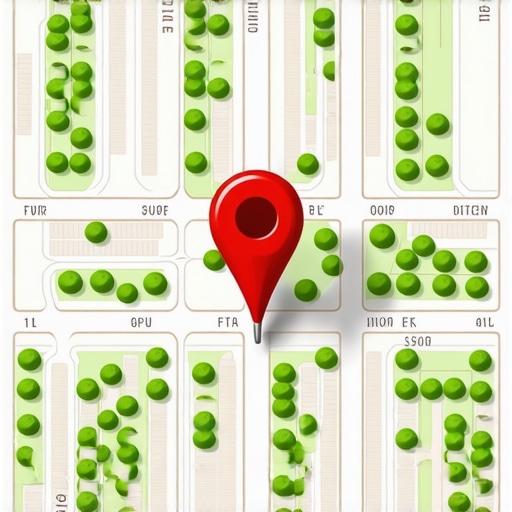
To diagnose these issues, you should regularly use local seo tools to monitor your rankings across a grid. A single-point search from your office is useless; you need to see how your pin performs from the perspective of a homeowner five miles north versus five miles south. If you see “dead zones” in your service area, it’s a clear sign of a proximity filter or a data conflict.
If you suspect your profile has been suppressed, check for these common triggers:
- Recent changes to your primary phone number or address.
- An influx of “spammy” reviews that Google’s filters might have flagged.
- Duplicate listings for the same physical location.
- Using a P.O. Box or a virtual office address (a major violation of Google’s terms).
Utilizing a professional google maps ranking service can help identify these technical glitches before they result in a permanent drop in lead flow. Proactive monitoring is the only way to ensure your google business profile seo remains effective in a shifting digital landscape.
Conclusion: Reclaiming Your Local Dominance
The “invisibility” of your pest control map pin isn’t a matter of bad luck; it’s a matter of data. Google’s algorithm is a complex machine that requires constant “feeding” in the form of relevance, prominence, and interaction signals. If you stop providing that data, your competitors will gladly take your place at the top of the Map Pack.
To dominate your local market, you must move beyond basic profile setup. You need to embrace the Ranking Accelerator philosophy. This means optimizing your categories, fostering verified interaction loops, solidifying your trust signals, and producing hyperlocal content that speaks directly to the neighborhoods you serve. You can see the results of this approach in my Ranking Accelerator Case Study: From Zero to Local Hero.
Visibility is not a “set it and forget it” game. Most small business owners don’t disappear because they’re lazy; they disappear because they stop feeding the algorithm interaction signals. Don’t let your map pin remain a ghost. Use a google maps ranking service or leverage local seo software to monitor your proximity and interaction speed. Start your Ranking Accelerator protocol today and ensure that when a homeowner is in need, your business is the first – and only – one they see.