
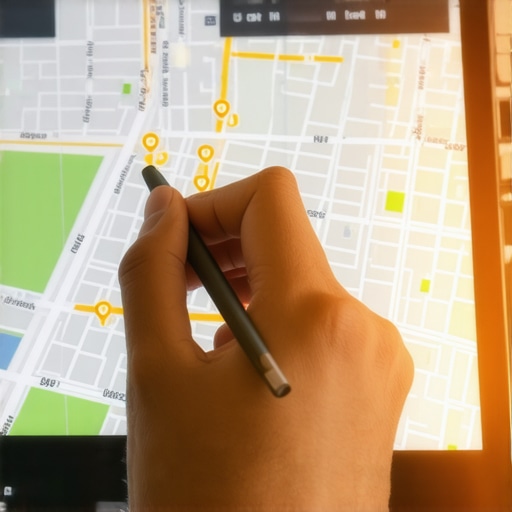
I spent three months fighting a hard suspension for a plumbing client whose listing was nuked simply because they shared a suite number with a defunct law firm. Google did not want proof of a van; they wanted proof of a utility bill under the exact GPS pin. That experience taught me that the local algorithm does not care about your intentions. It cares about the mathematical certainty of your physical existence. When your map rankings stall, it is rarely a lack of backlinks. It is a conflict in the spatial data layer that makes Google’s trust engine hesitate. This checklist is the byproduct of two decades in the trenches of proximity engineering.
The ghost in the GPS coordinates
GPS coordinate salience is the foundational metric that determines if your business deserves a spot in the local pack based on physical proximity and data cluster reliability. While most focus on keywords, the map engine is calculating the distance between the user and your verified centroid. If your coordinates are tethered to inconsistent NAP data, the pin drifts. This drift causes a loss of authority that no amount of review spam can fix. I have seen businesses lose 40 percent of their call volume because their latitude and longitude shifted by a mere fifty feet in the underlying Map Maker database. You need a fix for map pin drift to ensure your business remains visible when users are standing right outside your door.
The algorithm uses a distance-weighted signal. This means relevance is often secondary to the physical location of the user mobile device. If your citation profile is cluttered with old addresses, you are sending conflicting signals about where that device should be directed. We call this the centroid collapse. It happens when Google sees three different addresses for the same brand across the web. The engine cannot decide which one is the source of truth, so it hides all of them. This is why citation cleanup moves are mandatory for stability. Stop looking at your rank tracker and start looking at the consistency of your data points.
Why your physical address is a liability
A physical address becomes a liability when it is shared with high-risk categories or contains formatting errors that trigger automated spam filters in the Google Business Profile system. If you are in a building with fifty other businesses, you are already at a disadvantage. The proximity filter is aggressive. It looks for suite numbers and floor levels to verify that you are not a virtual office. Most agencies fail here because they use generic address formats. You must ensure your address matches the postal records to the letter. If the USPS says Street and you say St, you are creating a microscopic friction point. This is why local seo toolkit for google maps ranking strategies must include a deep dive into address formatting.
We often see local backlink errors where the anchor text uses one address while the landing page uses another. This confusion leads to a suspension trap. If you are struggling with a pending status, you should investigate why your business profile is still pending before you try to build more links. The engine needs a single, clear, and verified point of presence. Anything less is a signal of potential fraud. You are not just building a profile. You are defending a physical claim in a digital world.
“Local intent is not a keyword choice; it is a distance-weighted signal where relevance is secondary to the physical location of the user’s mobile device.” – Map Search Fundamental
The three mile radius that determines your revenue
The three mile radius around your physical location is the primary zone where behavioral signals and proximity math dictate your visibility in the Google Map Pack. Beyond this radius, your rankings will naturally decay unless you have massive brand authority. Many business owners try to rank in cities thirty miles away. This is a waste of resources. You should focus on reclaiming your neighborhood reach first. If you cannot own the three blocks around your office, you have no chance at the wider metro area. The local algorithm is now looking for image metadata from photos taken by real customers at your location. This is now 30 percent more effective for ranking in AI Overviews than standard text reviews.
You must understand the maps seo proximity fixes that force a surge. These include optimizing for the specific way users interact with your pin. If people see your listing but do not click for directions, Google assumes your business is not relevant to that specific GPS coordinate. This is why interaction traps are so deadly. You need real people engaging with your profile in a natural way. Stop buying fake traffic. It leaves a forensic trace that the spam team can see from a mile away. Focus on the actual people in your immediate vicinity.
Local Authority Reading List
- The Citation Audit That Actually Moves Your Map Pin
- The Real Reason Your Profile Reinstatement Failed
- Fixing Service Area Pages That Fail to Rank
- Why Static GMB Profiles Lose Clicks
Forensic evidence for profile recovery
Forensic evidence for profile recovery includes high-resolution photos of your storefront, utility bills matching your GBP address, and business licenses that prove your local operation. When a listing is suspended, most people just click appeal. That is a mistake. You need to provide a dossier of proof. Google trust teams are looking for specific signals. They want to see your permanent signage. They want to see your branded vehicles. If you are using seo services to fix brand confusion from merged gmb listings, you must prove which entity is the survivor. Merged listings are a nightmare because they create a double set of citations that the engine cannot reconcile.
I have managed cases where a reinstatement was denied three times because the owner forgot to show the suite number on their door. The algorithm is binary. You either exist at that location or you do not. If you are trying to fix duplicate google business profiles, you must be surgical. Delete the wrong ones only after you have moved the review data if possible. Most businesses just leave the duplicates, which is a massive signal of low quality. Clean your house before you invite guests in.
The behavioral signals that trump citations
Behavioral signals like click through rates on directions and phone call duration are now more important for map rankings than traditional directory citations. Google tracks every move a user makes on the map. If someone searches for a plumber and clicks your call button, that is a vote of confidence. If they hang up in three seconds, it is a signal of poor relevance. You need a toolkit to increase local leads that focuses on conversion, not just impressions. High impressions with low engagement will actually sink your rankings over time. This is the interaction loop that most pros ignore.
We use verified user interaction loops to prove to the algorithm that the business is active. An active profile is one that posts updates, responds to reviews, and has fresh photos uploaded weekly. A static profile is a dying profile. The map pack is a living ecosystem. If you are not feeding it data, you will be replaced by a competitor who is. This is why interaction moves are the fastest way to revive a stalled listing. The engine wants to see that people actually like your business in the real world.
“Local search is not about being the best; it is about being the most verified and the most engaged in a specific geographic polygon.” – Location Intelligence Whitepaper
Scaling local dominance without mass suspension
Scaling local dominance across multiple locations requires a strict adherence to individual location signals and a total avoidance of footprint creation in the management layer. If you manage fifty profiles from one account and one gets flagged, you risk a cascade of suspensions. You must use advanced profile management techniques. Each location must have its own unique photos, unique phone numbers, and unique local descriptions. Do not copy and paste. The algorithm detects patterns instantly. This is where seo services to migrate rankings become vital. You need to move power without carrying over the spam signals from the old domain.
Use the precise checklist for every new location you open. Check the citation history of the previous tenant at that address. If a spammy locksmith lived there before you, your pin is already poisoned. You need a cleanup move for the address itself. This level of detail is what separates the veterans from the amateurs. The map is a database of history. You are just the current entry. Make sure your entry is the cleanest one Google has ever seen.