Stop Guessing: The Right Way to Track Your Map Keyword Rankings
I’ve seen it a thousand times. A business owner sits at their desk, types their primary service into Google, and sees their business sitting pretty at #1 in the Map Pack. They smile, close the laptop, and assume the phone will start ringing off the hook. But three miles away, in a busy suburb where their ideal customers actually live, that same business is completely invisible. It’s not even on the first page of the maps. It’s “Local Ghosting” in real-time.
This is the “Invisible” Business Problem. If you are relying on a single search from your office – or worse, a traditional rank tracker that gives you one “average” number for an entire city – you are flying blind. In the world of 2025 and 2026 Local SEO, “average rank” is a vanity metric that kills ROI. The reality is that Google’s Proximity Filter is more aggressive than ever. Your visibility isn’t a static number; it’s a living, breathing, and fluctuating geographic boundary.
As a Google Business Profile (GBP) Product Expert, I’ve spent years dissecting how the algorithm decides who gets the calls and who gets ignored. To dominate your market, you must stop guessing and start measuring the right way. If you want to see how we’ve taken businesses from total obscurity to market leaders, check out our Ranking Accelerator Case Study: From Zero to Local Hero. Today, I’m going to show you how to track your true reach using GeoGrid technology and interaction signals.
Section 1: Why Traditional Rank Tracking Fails Local Businesses
For decades, SEO was built on “blue links” – the national organic search results. In that world, if you ranked #4 for “personal injury lawyer,” you were usually #4 for everyone in the country. But the Map Pack (the local 3-pack) operates on an entirely different set of physics. It is governed by three pillars: Proximity, Relevance, and Prominence.
Traditional rank tracking tools treat the Map Pack like organic results. They ping Google from a single IP address or a broad zip code and report back a single position. This is fundamentally flawed because Google Maps gives a different result every 500 meters. If your tracker pings from the north side of town, but your business is on the south side, the data is useless. You might be #1 at your front door and #20 at the local shopping mall just two miles away.
Furthermore, the Map Pack is highly dynamic. We are seeing increased “Map Pack turbulence,” where Google rotates the 3rd spot frequently to test how users interact with different businesses. If your tracking tool only checks once a week, it misses these vital shifts. To truly understand your performance, you need specialized local seo tools that can simulate searches from hundreds of specific coordinates simultaneously. Without this granular data, you aren’t doing SEO; you’re just hoping for the best.
Section 2: The GeoGrid Revolution: Visualizing Your Real Reach
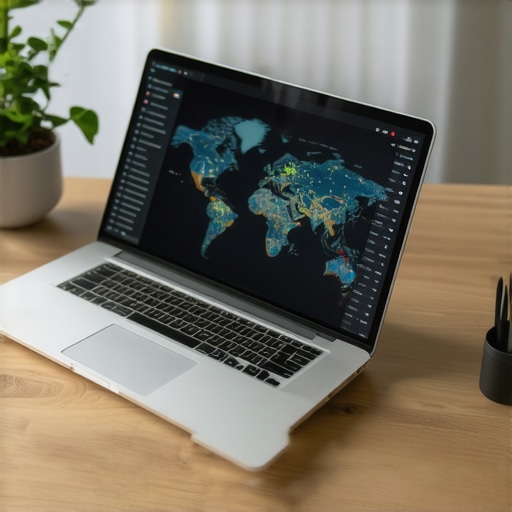
If you want to rank google business profile assets effectively, you have to move beyond spreadsheets and into GeoGrids. A GeoGrid is a visual map overlaid with a grid of nodes. Each node represents a specific GPS coordinate. When you run a report, the tool checks your ranking at every single one of those points.
This creates a heat map of your visibility. Green nodes (1, 2, or 3) show where you are dominating. Red or yellow nodes show where you are losing ground. This visualization is revolutionary because it identifies “ranking holes.” For example, you might notice that you rank #1 everywhere to the East of your office, but you disappear the moment you cross a major highway to the West. This tells you that there is a physical or algorithmic barrier – perhaps a competitor or a lack of localized content – that needs to be addressed.
Understanding this is key to google business profile optimization. When you see a “hole” in your GeoGrid, you don’t just “do more SEO.” You target that specific area with geo-relevant updates and localized reviews. This is how you stabilize your position against “Map Pack turbulence.” By using a high-quality google maps rank tracker, you can see exactly where the algorithm is testing your competitors and where your “proximity fence” ends. For a deeper dive into expanding these boundaries, read our guide on Optimizing Maps for SEO: The Ultimate Guide for 2025.
Section 3: Beyond Rankings: Tracking Interaction & Signal Loops
Here is a hard truth: ranking #1 isn’t the end goal. I’ve seen businesses rank #1 for high-volume keywords and still get zero phone calls. Why? Because their profile lacked the “Interaction Signals” that Google uses to validate its rankings. In 2025 and 2026, Google isn’t just looking at your address; they are looking at Verified User Interaction Loops.
Google tracks what happens after a user finds you. Do they click “Call”? Do they request directions and actually drive to your location? Do they spend time reading your reviews? This is where google business profile seo becomes more about user psychology than just keywords. A high Click-Through Rate (CTR) can actually move your map pin further than proximity alone. If Google sees that people from 10 miles away are consistently choosing your business over someone closer, it will “break” the proximity circle and rank you higher in those distant areas.
This is what we call “Signal Syncing.” You need to track not just where you rank, but how users are interacting with your profile at those specific locations. Are you getting “Map Pin Click Speed” (how fast a user clicks after seeing your result)? Are you getting “dwell time” on your photos? Tracking these interaction signals is the only way to ensure your rankings convert into revenue. To learn the technical side of this, see How to Actually Force a GMB Boost Using Verified User Interaction Loops.
Section 4: Common Tracking Mistakes That Lead to Bad Decisions
Most agencies and business owners make three critical errors when monitoring their local presence. First, they treat Map Pack and Organic results as the same. They think that because their website is on page 1 of the blue links, their map pin is safe. This is a dangerous assumption. Organic SEO is about your website’s authority; Map SEO is about your physical entity’s relevance and proximity.
Second, they ignore “Proximity Bleed.” This is the phenomenon where your rank gradually drops as you move away from your verified address. If you don’t use a google business profile audit tool to measure the rate of this bleed, you won’t know if your optimization efforts are actually expanding your reach or just reinforcing your current small circle. You need to know if your “Green Zone” is growing month-over-month.
Third, many overlook “map pin drift.” Sometimes, Google’s internal mapping data shifts, or a competitor suggests an edit that moves your pin slightly. Even a 50-foot move can change your ranking in a high-density city. Constant google maps optimization and monitoring are required to ensure your data remains accurate. If you aren’t checking for these subtle shifts, you’re making decisions based on stale or incorrect data.
Section 5: The 2026 Local SEO Checklist for Accurate Monitoring
As we head into 2026, the complexity of local business seo will only increase. To stay ahead, you need a rigorous monitoring schedule. It’s no longer enough to check your rankings once a month when you get your report. Here is the checklist we use for our high-level clients:
- Frequency: Weekly tracking is the baseline. For high-competition niches like Personal Injury Law or HVAC, daily tracking is necessary to catch competitor moves.
- Competitor “Live Inventory”: Monitor if competitors are using “Service Area” changes or “Live Inventory” updates to steal relevance in your backyard.
- Map Pin Click Speed: Use local seo software to analyze how quickly users engage with your profile compared to the two businesses next to you in the 3-pack.
- Geo-Fenced Reviews: Ensure you are tracking the geographic origin of your reviews. Reviews from users physically located in your target “ranking holes” carry significantly more weight.
By following this checklist, you move from reactive to proactive. You’ll be able to spot a ranking drop before it turns into a lead drought. For more advanced tactics, check out 5 Maps SEO Proximity Fixes to Force a 2026 Rank Surge.
Section 6: Troubleshooting: Why Your Profile Isn’t Showing Up
Sometimes, despite your best efforts, your profile simply vanishes. We call this “Local Ghosting.” It can be caused by a variety of factors: a shadow suspension, a “Missing Signal Loop,” or an aggressive proximity filter from a new competitor. When this happens, a standard gmb seo tools suite might not be enough. You need to diagnose the “Entity Health” of your profile.
If you find yourself invisible, you may need a professional google maps ranking service or gmb ranking service to perform a deep-clean of your citations and interaction signals. Often, the issue is that Google has lost trust in your location data. You need to re-establish that trust through verified map shares and geo-fenced interactions. Don’t let your business sit in the shadows. Learn How to Stop 2026 Map Ghosting with 3 GMB Boost Tweaks and start reclaiming your territory. To get a head start on your recovery, you can use rank higher on google maps strategies and leverage the power of SEO Viper Tools to audit your current standing.
Conclusion: From Tracking to Dominance
Tracking is the “diagnostic,” but optimization is the “cure.” In the hyper-local landscape of 2025 and 2026, you cannot afford to guess where you stand. Every red node on a GeoGrid is a customer going to your competitor. Every missed interaction signal is a lost opportunity to prove your relevance to Google.
Stop settling for “average” numbers. Start using google maps marketing strategies that rely on hard, geographic data. When you can see exactly where you are winning and losing, you can allocate your budget with surgical precision. Whether you are a solo plumber or a multi-location law firm, the path to dominance begins with accurate, real-time tracking. Don’t leave your google business profile ranking to chance. Contact Us today to see how we can turn your Map Pack presence into a lead-generation machine.