Why Most Plumbers Miss the Local Map Pack for High-Value Emergency Calls
For a plumbing business, the “emergency call” is the lifeblood of high-margin revenue. When a homeowner discovers a burst pipe at 2:00 AM or a water heater failing on a Sunday morning, they aren’t conducting a week-long research project. They aren’t scrolling through page two of the search results, and they certainly aren’t clicking on blog posts about the history of PVC piping. They are looking for one thing: a solution, right now.
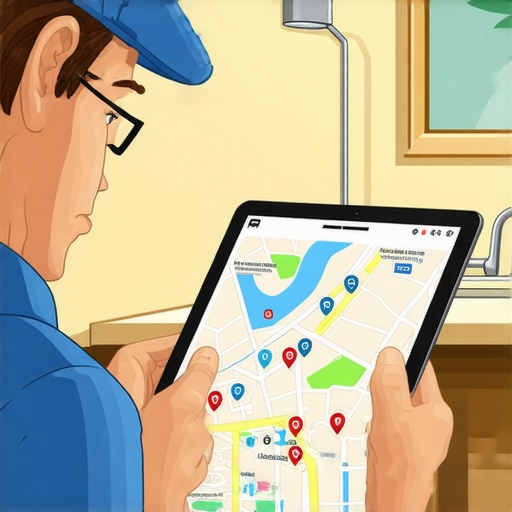
In these high-stakes moments, the Google Local Map Pack – the “3-pack” of map listings at the top of the search results – is the only thing that exists. Research shows that 46% of all Google searches have local intent, and for urgent services like plumbing, that number skyrockets. Yet, despite the massive opportunity, a staggering number of plumbing contractors remain invisible when it matters most. Even though 42% of local searches result in a Map Pack appearance, most plumbers find themselves buried beneath competitors who may not even have as many years in the business or as many trucks on the road.
The reality is that Map Pack listings capture over 44% of clicks for local searches. If you aren’t in those top three spots for “emergency plumber near me,” you aren’t just losing a lead; you are handing a high-value, high-intent customer directly to your competitor. This guide explores the technical and strategic reasons why most plumbers miss the mark and how to reclaim your territory.
The Psychology of the Emergency Plumbing Search
To understand why google business profile seo is so critical, we have to look at the psychology of the user. There is a fundamental difference between “discovery” searches and “distress” searches. When a consumer searches for “kitchen remodeling ideas,” they are in a discovery phase. They will browse websites, look at galleries, and read reviews over several days.
An emergency plumbing search is a distress search. The user is in a state of heightened cortisol. They need a professional who is nearby, available, and credible. Because 88% of consumers are influenced by local search results when choosing a plumber, the Map Pack acts as a psychological shortcut. The presence of the map, the star rating, and the “Open Now” tag provides immediate validation.
In a crisis, users don’t scroll past the top three results. They look for the call button. If your business isn’t there, you don’t exist in their world. This is why specialized local map pack seo is the difference between a $2,000 emergency pipe repair job and a silent phone. You aren’t just competing on price or service quality; you are competing for “visual real estate” at the exact moment of need.
The “Broad-Net” Trap: Why Your Service Area is Killing Your Rank
One of the most common mistakes I see in the plumbing industry is the “Broad-Net” strategy. Business owners, understandably wanting to maximize their reach, tell Google they serve a 50-mile or even a 100-mile radius. While this seems logical – more area equals more customers – it is actually a primary cause of ranking failure for urgent local calls.
Google’s algorithm prioritizes proximity above almost everything else for emergency queries. When you claim a massive service area without the localized signals to back it up, you dilute your relevance. Google becomes “confused” about where your primary base of operations actually is. Instead of being the “authority” in a 5-mile radius, you become a “nobody” in a 50-mile radius.
The data is clear: a plumbing company with fewer service pages but stronger, hyper-local signals consistently outperforms a large site with weak visibility across a broad region. When you try to be everywhere, Google’s proximity filter often decides you are nowhere. To win the Map Pack, you must prove your local density. You can learn more about this in my deep dive on [How to Fix Service Area Pages That Fail to Rank in the Local Pack].
Beyond NAP: The Interaction Signals You’re Ignoring
For years, the mantra of local SEO was “NAP” (Name, Address, Phone number). While consistency across directories is still a baseline requirement, it is no longer the “secret sauce” for ranking. Today, Google looks at “User Interaction Loops.”
Google’s goal is to provide the best user experience. If a user searches for a plumber, sees your profile, but doesn’t click “Call,” “Directions,” or “Website,” Google receives a signal that you might not be the best fit for that specific query. Conversely, if your profile sees a high volume of engagement – people clicking to call you or searching for your brand name specifically – your authority rises.
If no one is interacting with your profile, Google assumes you aren’t relevant to the local community. To rank higher on google maps, you must drive real, organic engagement. This involves more than just “setting and forgetting” your profile; it requires a proactive strategy to ensure your listing is the most attractive and interactive option in the 3-pack. For those looking for advanced tactics, I’ve outlined the process in [How to Actually Force a GMB Boost Using Verified User Interaction Loops].
3 Technical Gaps That Sink Plumbing Rankings
Even if you have a great reputation, technical oversights in your digital presence can act as a ceiling on your rankings. Here are the three most common gaps I see when auditing plumbing businesses.
Category Confusion & Service Misalignment
Your primary category on your Google Business Profile (GBP) is the single most important on-page ranking factor. Many plumbers mistakenly set their primary category to something generic or secondary, like “Drainage Service” or “Heating Contractor,” when their main revenue driver is general plumbing. While you can add sub-categories, your primary category must align with the highest-intent search terms (usually “Plumber”). If there is a mismatch between your primary category and the user’s search intent, you will likely be filtered out of the top results.
The Local Schema Markup Error
Schema markup is the hidden code that tells search engines exactly what your data means. Many plumbers have broken or missing LocalBusiness Schema on their websites. Without this, Google has to “guess” the connection between your website and your Map Pin. Proper Schema should include your exact coordinates, your service area, and a “hasMap” property that links directly to your GBP CID (Customer Identification) number. Missing this connection is a common reason for search visibility tanking. I go into more detail on this in [The Local Schema Markup Errors That Are Tanking Your Search Visibility].
Review Velocity vs. Review Volume
Many plumbers think that having 100 reviews from three years ago is enough. It isn’t. Google prioritizes Review Velocity – the speed and consistency at which you acquire new reviews. In a local search surge, 5 fresh reviews from the last month are often worth more than 100 old reviews. Furthermore, the keywords within those reviews (e.g., “best emergency plumber in [City]”) act as powerful ranking signals. Utilizing the right local seo tools can help you track this velocity against your competitors.
Breaking the Proximity Filter in 2026
As we move toward 2026, the competition for the Map Pack is becoming hyper-localized. Google is getting better at identifying where a plumber’s trucks actually are versus where their office is located. To expand your ranking radius beyond your immediate neighborhood, you need to implement “Geo-Signals” and “Signal Syncing.”
Signal Syncing involves ensuring that every photo you upload to your GBP is geotagged (either through EXIF data or through the location where the photo was taken) and that your website content mentions specific neighborhood landmarks, zip codes, and local projects. By using a professional google maps ranking service, you can prove to Google that your “relevance” extends 10 or 15 miles out from your office. This is how you beat the proximity filter and capture leads in the wealthy suburbs even if your shop is in the industrial district. For a technical breakdown of this move, check out [Why Your Proximity Signal Fails Without This Specific Ranking Accelerator Move].
The Plumber’s Google Business Profile Audit Checklist
If you want to stop missing out on emergency calls, you need to treat your Google Business Profile as a living asset, not a static listing. Use this checklist to identify immediate opportunities for google business profile optimization:
- Primary Category Check: Ensure “Plumber” is your primary category unless you are a strictly specialized shop.
- Photo Freshness: Upload at least 3-5 new photos per week. Focus on your branded trucks, your team in uniform, and “before and after” shots of local jobs.
- Q&A Optimization: Don’t wait for customers to ask questions. Post your own Frequently Asked Questions (e.g., “Do you offer 24/7 emergency pipe repair in [City]?”) and answer them yourself.
- Review Response: Respond to every single review within 24 hours. Include keywords and the name of the town in your response.
- Booking Integration: Use the “Booking” or “Reserve with Google” feature to allow emergency customers to schedule a call directly from the search results.
- Service Menu: Ensure every specific emergency service (Sump Pump Repair, Burst Pipe, Water Main Leak) is listed individually in your Services tab.
For a more exhaustive list, see my guide on [7 Missed Steps in Your Google Maps Ranking Checklist].
Conclusion: Reclaiming Your Neighborhood Reach
The battle for plumbing leads is no longer fought on billboards or in the Yellow Pages; it is fought in the three inches of screen space known as the Local Map Pack. When a homeowner is standing in a flooded kitchen, they need a hero, and Google’s job is to find them one immediately. If you aren’t visible, you can’t be the hero.
Stop relying on “broad-net” tactics that dilute your authority and start focusing on the hyper-local technical signals that Google demands. By fixing your categories, mastering your interaction loops, and maintaining a high review velocity, you can dominate your local market.
Ready to see how it’s done? Take a look at our [Ranking Accelerator Case Study: From Zero to Local Hero] to see real-world results from plumbers who reclaimed their rankings. For those who want to take a DIY approach with professional-grade data, visit SEO Viper Tools to explore the latest local seo software designed to give you the competitive edge in the Map Pack.