
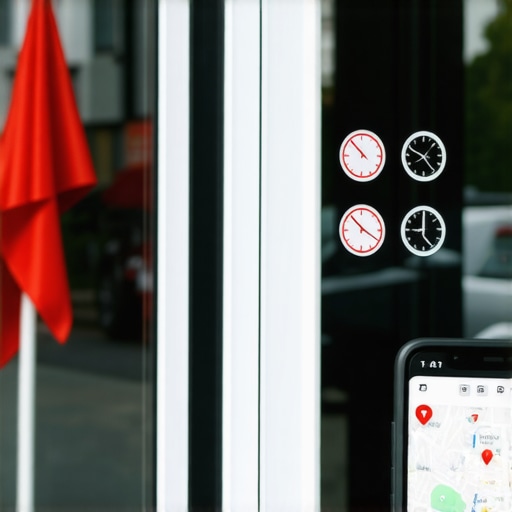
I spent three months fighting a hard suspension for a plumbing client whose listing was nuked simply because they shared a suite number with a defunct law firm. Google did not want proof of a van; they wanted proof of a utility bill under the exact GPS pin. The investigation revealed that the inconsistency was not just the address but a long history of erratic opening hours that suggested a business that did not exist in the physical realm. This historical data is the digital footprint that the algorithm uses to verify your legitimacy before it ever grants you a spot in the local pack. If your hours change every week without a clear seasonal pattern, you are signaling to the spatial database that your entity is unstable and potentially fraudulent.
The ghost in the GPS coordinates
Business hours history functions as a primary trust signal because it correlates with real world foot traffic patterns and local user behavior. When a business frequently updates its hours or leaves them inconsistent across multiple directories, it creates a conflict in the proximity beacon. This conflict triggers the vicinity filter, which is designed to prune out low trust entities that might lead to a poor user experience. Google prefers businesses that provide a predictable schedule; this reliability allows the algorithm to confidently recommend the listing to mobile users looking for an immediate solution within a specific radius. You can see how this plays out in our ranking accelerator case study from zero to local hero where stability was the catalyst for growth.
The logic of a check in signal is often misunderstood. When a user arrives at your storefront with their mobile device, Google tracks that visit against your stated opening times. If your profile says you are closed, but twenty people are standing at your coordinates, the system flags a data mismatch. Conversely, if you claim to be open until midnight but zero devices enter your polygon after 5 PM, the trust score for your entity begins to erode. This is why why your google business profile history matters more than you think; it is a cumulative record of your physical presence and operational honesty. Agencies that suggest you set 24/7 hours to capture more leads are actually setting you up for a proximity filter collapse once the behavioral data fails to match the claim.
Why your physical address is a liability
Your physical address becomes a liability when it is associated with high churn locations or service area businesses that try to hide their residential roots. The algorithm uses historical occupancy data to determine if a location is a legitimate commercial hub or a known map spam center. If you are operating from a shared suite or a virtual office, the hours you set must perfectly mirror the building operational hours. Any deviation from the master schedule of the property manager can trigger a manual review. This is the core reason the proximity secret why hiding your address changes everything during the verification process. When you hide the address, Google leans even more heavily on your secondary signals like website citations and social proof to verify your hours.
“Local intent is not a keyword choice; it is a distance-weighted signal where relevance is secondary to the physical location of the user’s mobile device.” – Map Search Fundamental
We often find that seo services to fix google ranking drop focus on backlinks while ignoring the messy opening hours history that keeps your business out of the map pack. The spatial database layer treats time as a third dimension of relevance. If a competitor is physically further away but has a ten year history of consistent 9 to 5 hours, they may outrank a closer business that has changed its schedule three times in the last quarter. This is because the algorithm prioritizes certainty. A user sent to a closed business is a failure of the search engine, so it will always bet on the most stable entity.
Local Authority Reading List
- The precise checklist that forces stalled google business profiles to rank higher
- How to sync your business hours across the web to boost trust
- The audit strategy that finds every gap in your business profile
- Why your google business profile clicks are dropping and how to reverse it
The three mile radius that determines your revenue
The three mile radius around your business is the combat zone where your hours and interaction signals determine your win rate in the map pack. Within this zone, the algorithm is hyper sensitive to user interaction loops. If a customer searches for your service while you are marked as open, but they call and get no answer, or if they click through and find a website with conflicting info, the interaction trap is set. You can learn more about this in our guide on the interaction trap that keeps your map pin stuck in the shadows. Every failed interaction is a negative vote against your profile authority. The system records the duration of the call and the subsequent user behavior, such as if the user immediately called a competitor after hanging up with you.
For those managing multiple locations, the danger is multiplied. If you are looking for how we successfully scaled local seo across 20 locations without profile suspensions, you must understand that Google looks for patterns across your entire brand. If five of your locations have inconsistent hours, the trust level for the sixth location is automatically lowered. This forensic trace of data across the web is why why your citation inconsistencies are hurting your map pin even if your primary GBP listing looks correct. The algorithm is comparing your stated hours against Yelp, Bing, and even your local chamber of commerce directory.
Tactical remediation for volatile map rankings
Stabilizing volatile map rankings requires a forensic audit of every digital mention of your business hours and a rigorous alignment of your local schema markup. You cannot simply change the hours on your profile and expect an immediate boost. You must first use the citation cleanup checklist for stalled map rankings to ensure that every secondary directory matches your desired schedule. This creates a unified signal that the trust teams can verify. If you are dealing with a suspension, you will need troubleshooting the profile suspension trap specific proof google trust teams require, which often includes a photo of your permanent signage showing those exact hours.
Furthermore, you should utilize the local schema markup errors that are tanking your search visibility to hardcode your hours into your website code. Using the openingHours property in JSON-LD provides a machine readable confirmation of your schedule. This acts as the authoritative source that Google uses to resolve conflicts with third party data. When this is coupled with a what is a gmb ranking toolkit, you can monitor how your hours are being interpreted by the AI overviews. The future of search is not just about being found; it is about being verified as a living, breathing part of the local community. [image placeholder]
“Consistency in temporal data is the quietest ranking factor, yet it is the first one Google uses to invalidate a high ranking competitor during a core update.” – Vicinity Research Group
If you have recently expanded, you might need local seo services to stabilize volatile map rankings after expansion. New locations are under a microscope for the first six months. During this period, avoid the temptation to adjust your hours for holidays without using the special hours feature. Deleting and recreating hours is a red flag. Use the holiday override instead to show the algorithm you are an active manager of your data. This attention to detail is what separates the veterans from the amateurs. It is about maintaining the flow of the dispatch system and ensuring the map remains a reliable tool for the neighbor looking for a dentist, a plumber, or a lawyer at 4 PM on a Tuesday.